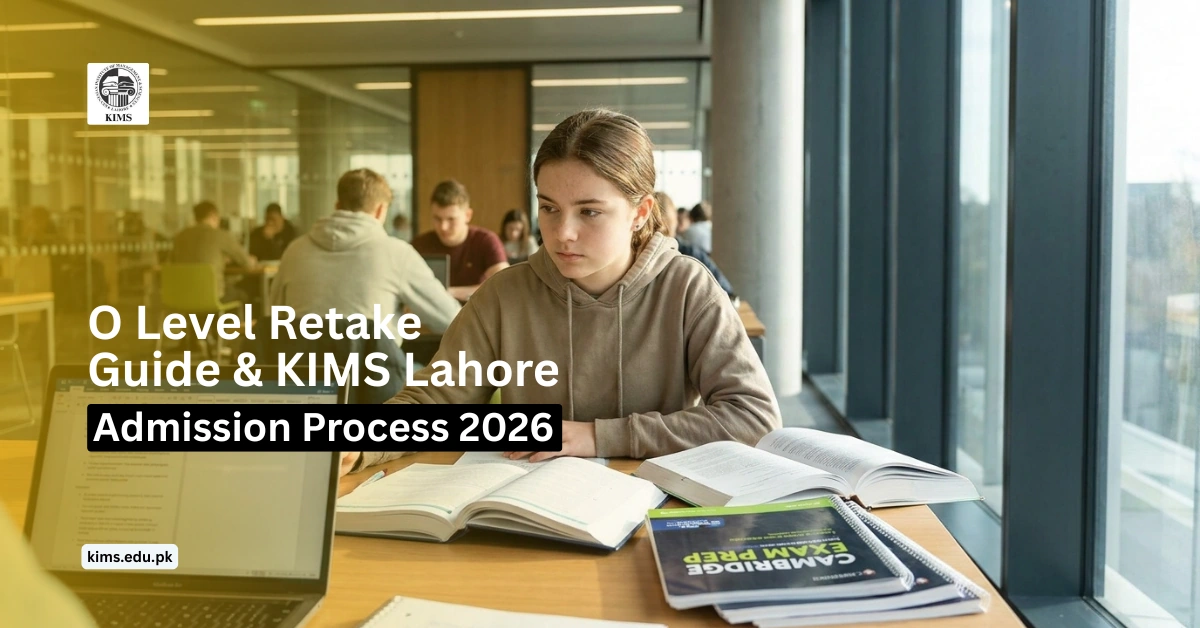
Getting your O Level results can be one of the most nerve wracking moments of a student’s life in Pakistan. And if those results didn’t go the way you hoped; trust me, you are not alone. Every year, thousands of students across the country find themselves staring at a grade they didn’t expect, wondering what comes next.
Failed an O Level subject? This guide explains Cambridge grading, O Level retake options in Pakistan, registration procedures, exam fees, study strategies, and how students can pursue admission opportunities at KIMS Lahore while improving their academic results through retake examinations.
Here’s the truth: a bad O Level result is not the end of the read. Not even close.
Why Students Struggle After O Level Results

The pressure of the Cambridge O Level system is real. Students are juggling eight to nine subjects, dealing with family expectations, managing school pressure and sometimes despite all the effort, one or two subjects just don’t land the way they should.
Some of the most common reasons students struggle include:
- Exam anxiety that hits on the day itself
- A particular subject that was genuinely difficult throughout the year
- Personal or health challenges during the exam period
- Poor paper presentation, even when content knowledge was solid
Whatever the reason, what matters now is what you do next.
How KIMS Support Student Admissions
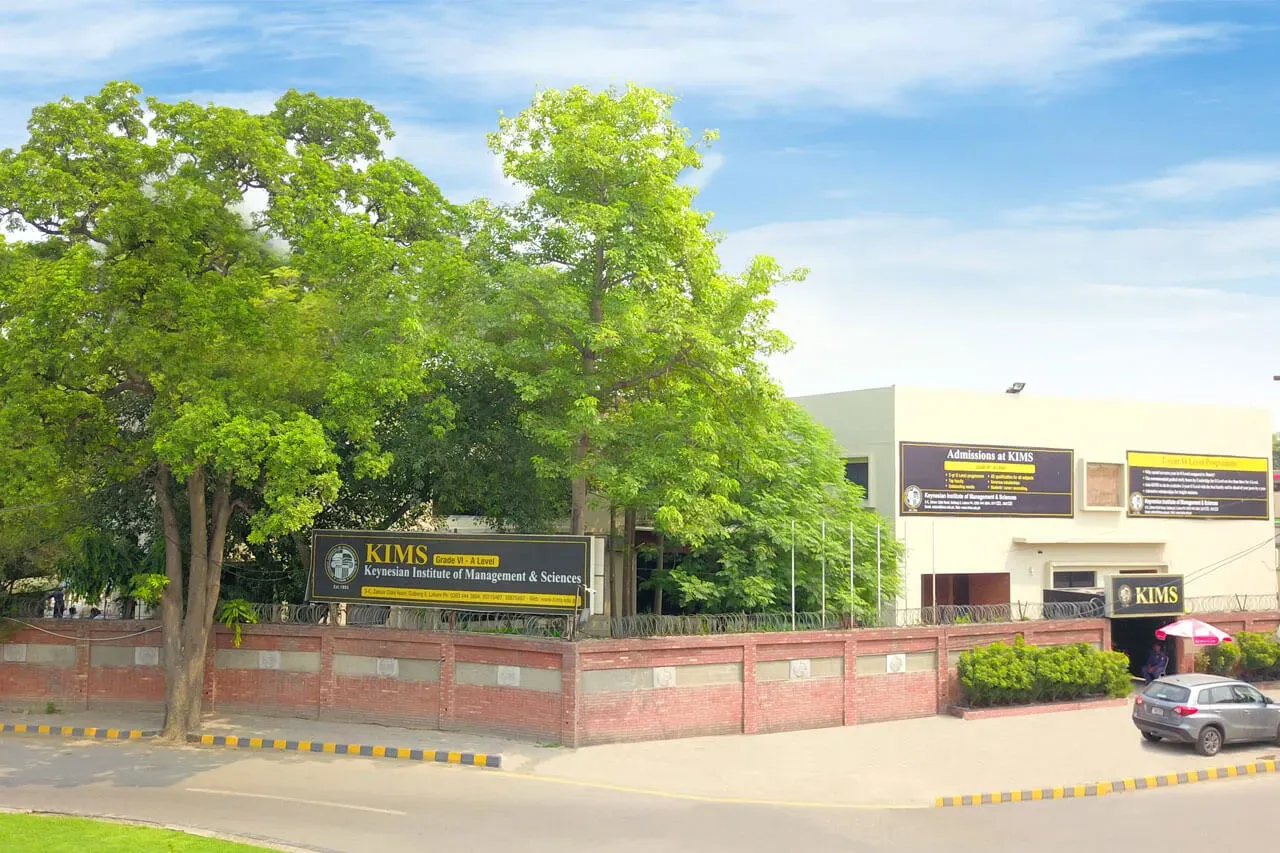
KIMS (Keynesian Institute of Management & Sciences) – understands that students are more than a single set of exam results. Their admission process takes a holistic approach, supporting students who are working through their O Level journey, including those who are in the process of improving their grades through retakes.
What Happens If You Fail an O Level Subject?
Before we talk about solutions, it helps to understand what “failing” actually means in the Cambridge system, because the grading structure is more nuanced than most people realize.
Cambridge Grading System Explained
Cambridge O Levels use a letter grading scale that runs from A* (highest) down to U (ungraded). Here’s how it breaks down:
| Grade | Description |
| A* | Outstanding |
| A | Excellent |
| B | Very Good |
| C | Good (Pass) |
| D | Satisfactory |
| E | Acceptable |
| F | Poor |
| G | Very Poor |
| U | Ungraded (Not Certificated) |
A grade of A* through E is technically awarded a certificate. However, for most college admissions in Pakistan, including medical and science based programs, a minimum of five credits (grades A* to C) is usually required, and specific subjects like Biology, Chemistry, Physics, English, and Mathematics need to meet a minimum grade threshold.
So if you receive a D, E or U in a required subject, you’ll want to look at your retake options seriously.
Impact on College Admissions in Pakistan
A below-requirement result in a key subject can delay your admission to an A Level programme or institution. That’s just the reality. But here’s what matters: it delays it — it doesn’t end it.
Many institutions, including KIMS, can discuss your options with you individually. Rather than assuming a door is shut, it’s worth contacting the admissions office directly. You might find more flexibility than you expect.
O Level Retake Options in Pakistan
The good news is that Cambridge gives you more than one way to retake a subject.
School-Based Retake System
If you’re still enrolled at a Cambridge affiliated school, the most straightforward option is retaking through your school. You’d speak to your school’s Cambridge coordinator, confirm that the subject is available in the next exam series, and re-register for the paper(s) you want to improve.
The advantage here is familiarity – you know the environment, you may have the same teachers available, and the administrative process is handled through the school.
Private Candidate Option
If you’ve already left school, or your school doesn’t offer the subject you need, you can appear as a private candidate. This means registering directly with a Cambridge centre exam, without being attached to any school.
In Pakistan, private candidates typically register through:
- British Council Pakistan – The official Cambridge representative, which offices in Lahore, Karachi, and Islamabad
- Registered Cambridge centres across major cities
This route suits students who are self-studying, attending a tuition centre, or who simply want flexibility of sitting an exam independently.
Step-by-Step O Level Retake Process
Here’s a practical walkthrough so you know exactly what you’re dealing with.
Registration Process in Pakistan
Step 1: Identify what needs improving: Pull out your result slip. Note the subject name, subject code, and the specific paper(s) where your grade fell short.
Step 2: Decide your route: Will you go through a school (yours or another Cambridge centre), or register as a private candidate? This affects your timeline and costs.
Step 3: Get in touch with the right people: For private candidates: Contact British Council Pakistan or search for Cambridge registered exam centres near you.
For school based retakes: speak to your school’s Cambridge coordinator.
Step 4: Gather your documents
You’ll usually need:
- Your Cambridge result slip
- CNIC or B-form copy
- Passport sized photographs
- Completed registration form
Step 5: Pay the registration fee and confirm your entry
Keep a copy of everything. Once your entry is confirmed, you’ll receive details of your exam schedule.
Exam Series Selection
Cambridge O Level exams run in two series each year:
- May/June Series – Exams held May to June, results released in August
- October/November Series – Exams held October to November, results released in January
If you received your results from the May/June sitting, your earliest retake opportunity is the October/November series of the same year, giving you roughly three to four months to prepare. That’s a meaningful window if you use it well.
Fee Structure Overview
Retake fees in Pakistan vary depending on how you register and which subject you’re sitting:
- School based retakes tend to be lower cost, as fees are processed through the Cambridge centre
- Private candidate fees via British Council generally range from PKR 8,000 to PKR 15,000+ per subject, depending on the paper and series
Always confirm the current fee with your registration point directly, as these figures are updated each session.
Admission Opportunity at KIMS After O Level
Now let’s get to what most of you are really thinking about, what comes next, and how KIMS fits into that picture.
Eligibility Criteria for KIMS Admissions
KIMS offers an O Level programme as well as an A Level programme for students who have completed their O Levels. For A Level admission, students are generally expected to have completed their O Levels with good grades in relevant subjects.
The admissions process at KIMS is straightforward. As stated on our website: admission is offered to candidates based on the results of their previous class, and in some cases, applicants may need to sit an admission test. If your O Level results are pending, whether original or retaken, it’s worth reaching out to KIMS directly to discuss your specific situation.
You can contact the KIMS admission team at:
- Phone: +92 (303) 444-3804
- Email: admin@kims.edu.pk
- Address: 3-C, Zahoor Elahi Road, Gulberg II, Lahore
Programs Available After O Level
KIMS offers a well structured A Level programme for students who have completed their O Levels. Given KIMS’s Cambridge Associate School status and over 30 years of experience, the A Level program is academically rigorous and comes with the kind of faculty and infrastructure that genuinely prepares students for university.
Beyond academics, KIMS provide:
- Career counselling and subject selection guidance (including one-on-one sessions with the Principal)
- Co-curricular activities ranging from science fairs and math competitions to sports and arts events
- Modern facilities including air-conditioned classrooms, science and IT labs, a library, and a student lounge
For the full list of programmes and current intake details, visit kims.edu.pk
How To Apply At KIMS
The application process is designed to be simple and accessible:
- Visit kims.edu.pk and go to the Admissions section
- Fill out the Admission Enquiry Form or full Admission form, both available online
- Attach required documents, O Level results (or pending result slip), CNIC/B-form, photographs
- Submit your application, online or by collecting a hard copy from the school office
- Appear for an admission test if required, not all applicants need one
- Receive your fee bill once admission is confirmed, and complete enrollment by paying the fee
If your retake results are still awaited, contact the admissions office to let them know your timeline. It’s better to start the conversation early rather than wait until everything is in hand.
Best Strategy To Pass Retake Exams
Knowing the process is one thing. Actually performing better in your retake is another thing. Here’s what genuinely works.
Study Planning Tips
Three to four months between sittings is enough time to make a real difference, but only if you structure it properly.
Start by understanding why you lost marks, not just that you did. Cambridge publishes Examiner Reports for every subject and series. These documents explain exactly where students commonly went wrong. Read one of your subjects. It’ll tell you more than ten hours of re-reading your textbook.
Building a weekly revision plan that prioritizes your weak areas without abandoning the topics you already know. Assign realistic daily targets and stick to them. Two focused hours everyday will consistently beat one panicked all nighter before the exam.
Don’t try to cover everything equally. Look at the mark weightings in your syllabus. Some topics carry far more marks than others. If you’re limited on time, protect those sections first.
Past Paper Practice Method
If there’s one single thing that makes the biggest difference in Cambridge O Level exams, it’s past paper practice, and doing it the right way.
Cambridge past papers are publicly available and directly mirror the style, format, and question types of your actual exam. Here’s the method that works:
- Complete a full past paper under proper timed, exam conditions, no phones, no breaks, no looking at notes
- Mark it using the official Cambridge mark scheme (also publically available)
- Go through every question where you dropped marks and identify why; was it a knowledge gap, a misread question, or a formatting issue?
- Return to your notes or textbook and close that specific gap
- Repeat with the next paper
Aim to work through at least eight to ten full past papers before your exam. By the time you’ve done that many, the question formats feel familiar, the time pressure is manageable, and your confidence going into the exam is completely different.
FAQs
Can I apply to KIMS after getting low O Level grades?
Yes, you can; and you should reach out rather than assuming your application won’t be considered. KIMS assesses admissions on the basis of your previous results, and in some cases an admission test. If you’re in the process of retaking a subject, contact the admissions team at admin@kims.edu.pk or call +92 (303) 444-3804 to discuss your situation before your retake results are out. Starting that conversation early is always a good idea.
How many times can I retake an O Level subject?
Cambridge International does not place a limit on the number of times you can retake an O Level subject. You can appear in the May/June or October/November series as many times as you need. Each attempt is treated independently, and institutions will typically consider your best result in any given subject.
Is retake result accepted for A Level admission at KIMS?
Absolutely. A retake result is a fully valid Cambridge credential, there is no distinction between a first-sitting result and a retake result on your certificate. Schools and colleges across Pakistan, including KIMS, consider retake grades in exactly the same way as original results.
What is the difference between registering through a school vs a private candidate?
The main differences are cost and logistics. School-based registration is generally handled by the Cambridge coordinator and may be slightly cheaper. Private candidate registration is done directly through British Council Pakistan or a registered exam centre, and gives you more flexibility; useful if you’ve already left school or need to sit a subject your school doesn’t offer.
Conclusion: Your Path From Retake to KIMS Admission
A difficult O Level result is not a full stop. It’s a comma; a pause before you figure out your next move.
The Cambridge system gives you multiple chances for a reason. Pakistan’s educational landscape has genuine entry points for students who are willing to put in the work to improve their grades.
And KIMS, with over 30 years of experience, a Cambridge Associate School standing, and a reputation built on the success of alumni ranging from musicians to Harvard graduates to international bankers, is the kind of institution that looks at who you are and where you’re headed, not just a single set of results.
Here’s your roadmap:
- Understand which grades need improving and why
- Register for your retake; through school or as a private candidate
- Prepare seriously: past papers, structured revision, examiner reports
- Get in touch with KIMS early to discuss your admission options
The students who succeed after a setback aren’t necessarily the ones with the most natural ability. They’re the ones who didn’t stop.